 Pretectal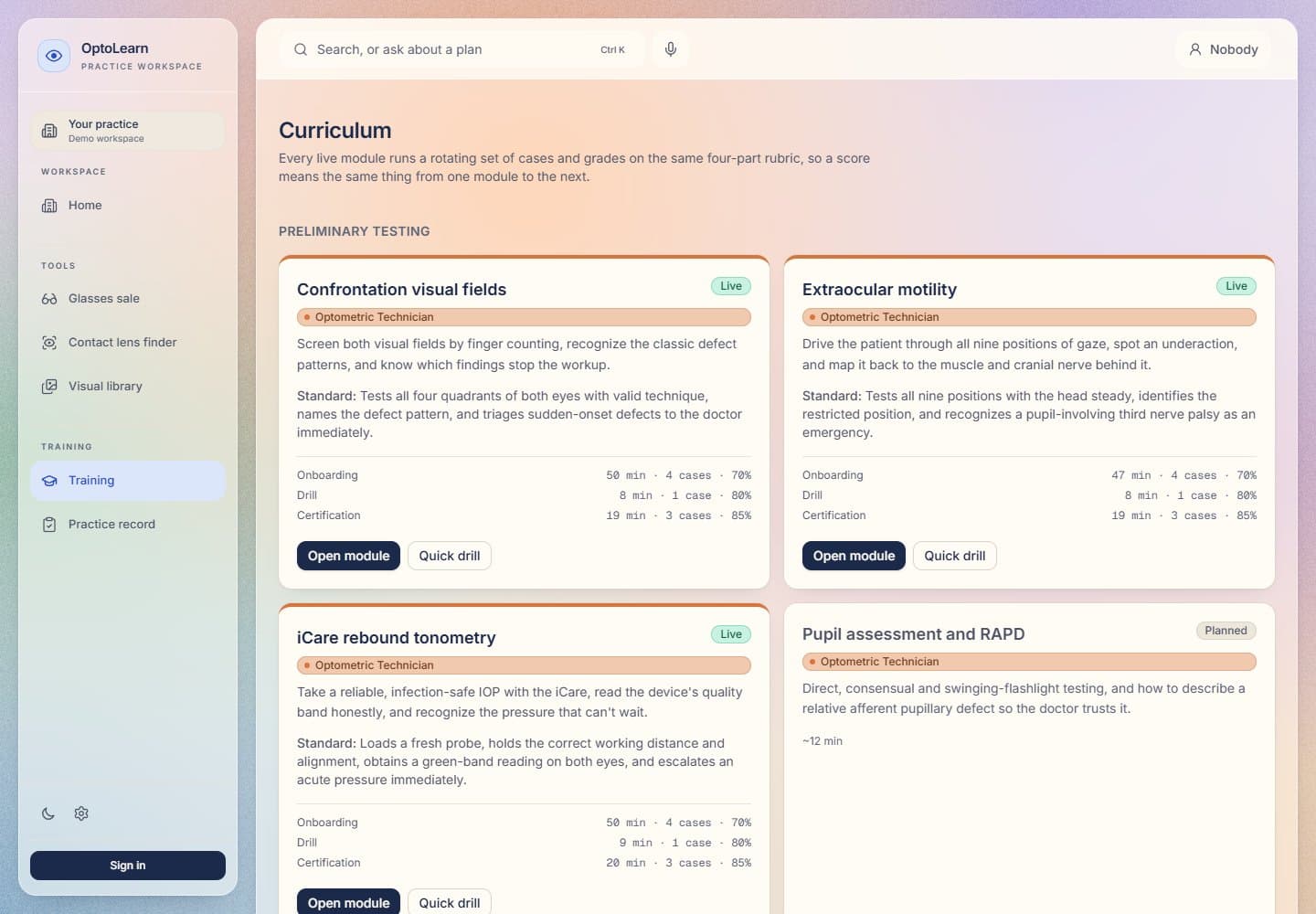
The problem worth solving
For new hires and optometric practice teams
New hires need a clear route from an explanation to supervised work. The team supporting them needs a shared structure for that training. OptoLearn turns this workplace need into a sequence of instruction, practice, and assessment alongside everyday references and tools.
The product decisions
01Organize the curriculum around a task
Live preliminary-testing modules cover confrontation visual fields, extraocular motility, and rebound tonometry. The curriculum distinguishes those modules from planned content.
02Separate supported practice from assessment
Onboarding introduces the material with guidance. Drill mode provides shorter practice. A separate assessment mode withholds coaching until the scorecard. Completing a guided lesson does not grant the product's internal certification.
03Keep learning close to the workplace
Training sits alongside practice links, visual references, and optical tools. The design connects preparation with the environment where the knowledge will be used; simulated performance still needs supervised application on the job.
What the evidence shows
A working training curriculum with preliminary-testing modules, guided onboarding, practice drills, and separate assessment modes.
Based on the public curriculum and implementation inspected October 2, 2026. This demonstrates a built training experience; practice adoption, time savings, and workplace performance outcomes are not reported here.
The capability this demonstrates
Recognizing a team need and translating it into a working product with distinct training modes. The curriculum demonstrates implementation; adoption and changes in training effort still need to be measured.
The lesson for your next product
Look for a task your team explains repeatedly. Map the steps with the people who do the work, then build one small tool around that task. Give guidance and assessment different purposes. Agree on what still requires a supervisor, and measure the existing process before claiming time savings.
My building workflow has evolved from MVPs with Lovable, Cursor, and Windsurf to Claude Code and ChatGPT Astra with skills. Choosing an AI assistant is one decision; choosing the tools that build and run your app is another. Explore the roles of Vite, Next.js, and backend services →
Suggested exercise
Try a small version with AI.
Use this brief to explore the product pattern in a prototype of your own. This suggested exercise adapts the interaction in OptoLearn into a small, reviewable build.
A brief to adapt
Turn a supplied, reviewed task checklist into a training prototype with two clearly labeled modes. In practice mode, show guidance and feedback. In assessment mode, withhold guidance until the final review. Use fictional learner data, show incomplete steps clearly, and avoid claiming workplace certification.
Check the result with a person.
- Have the person responsible for the task review the steps and feedback.
- Confirm practice hints do not appear during assessment and incomplete work is not marked complete.
- Test a new learner's route through the task, including restarting and correcting an answer.
For the educational content in your prototype: plan the review and delivery handoff →